The Eames Lounge Chair and Ottoman at 70
Celebrating the 70th anniversary of the Eames Lounge Chair and Ottoman—an enduring icon revealed through a prototype, material studies, and the Eameses’ design process.
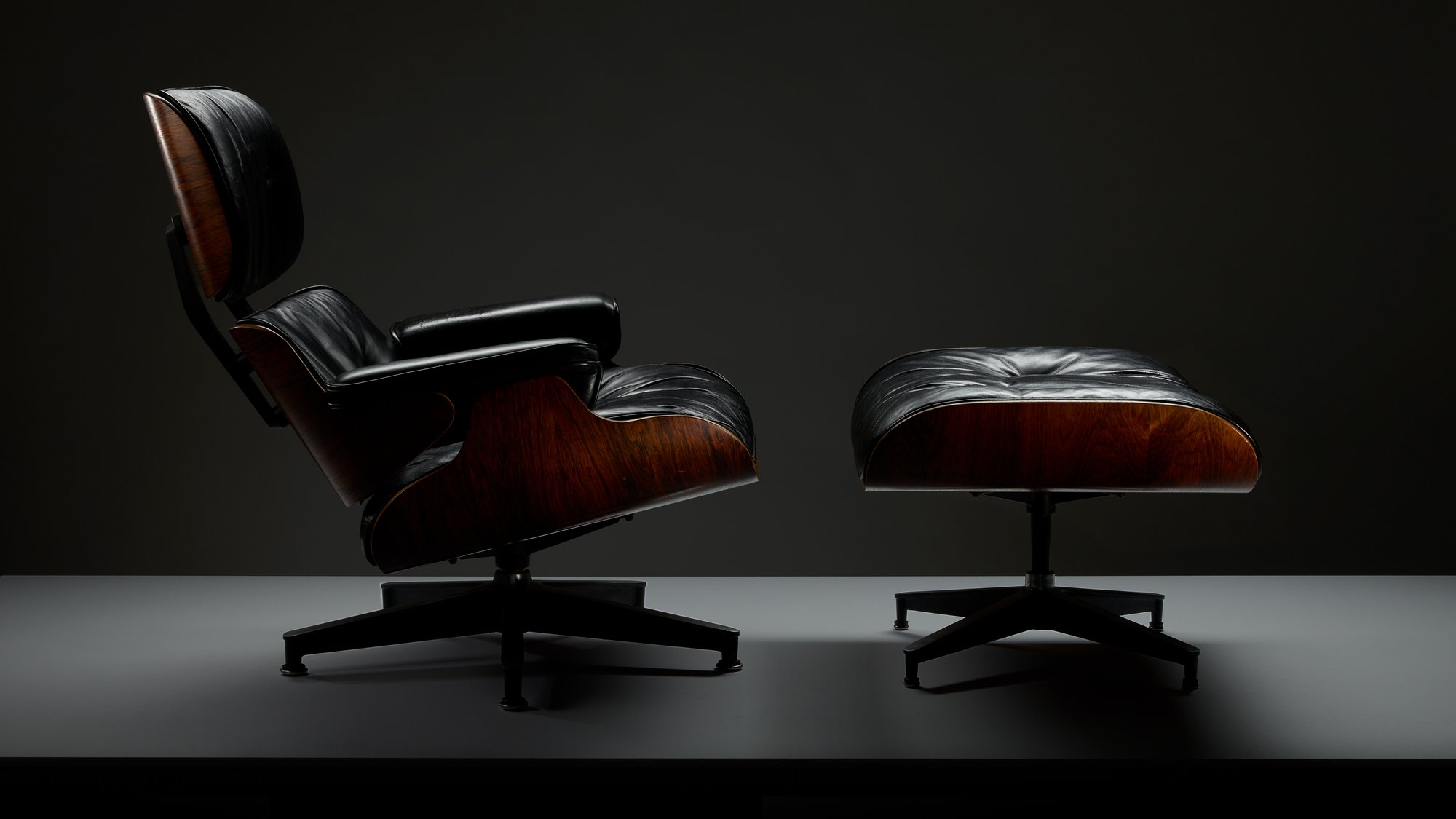
1962 Eames Lounge Chair and Ottoman.
This year marks 70 years since the introduction of the iconic Eames Lounge Chair and Ottoman, also known as model 670 and 671. It holds a particular place among the Eames designs as one of their most coveted works—the one that often comes to mind when people hear the Eames name. Its recognition is longstanding. It was awarded the Grand Prize at the 1957 Salon del Mobile in Milan, was granted a US design patent, and remains widely sold, continuing to attract new generations of buyers, despite being a premium product in cost and quality.
The Eames Institute holds more than 40,000 artifacts spanning every stage of the Eames design process. By preserving and presenting these materials, the Institute offers a unique window into how the designers achieved their results. Drawing from the Institute’s collection, the focus here is on understanding how the Eames Lounge Chair and Ottoman came to be. Even icons have origins. Everything starts somewhere.
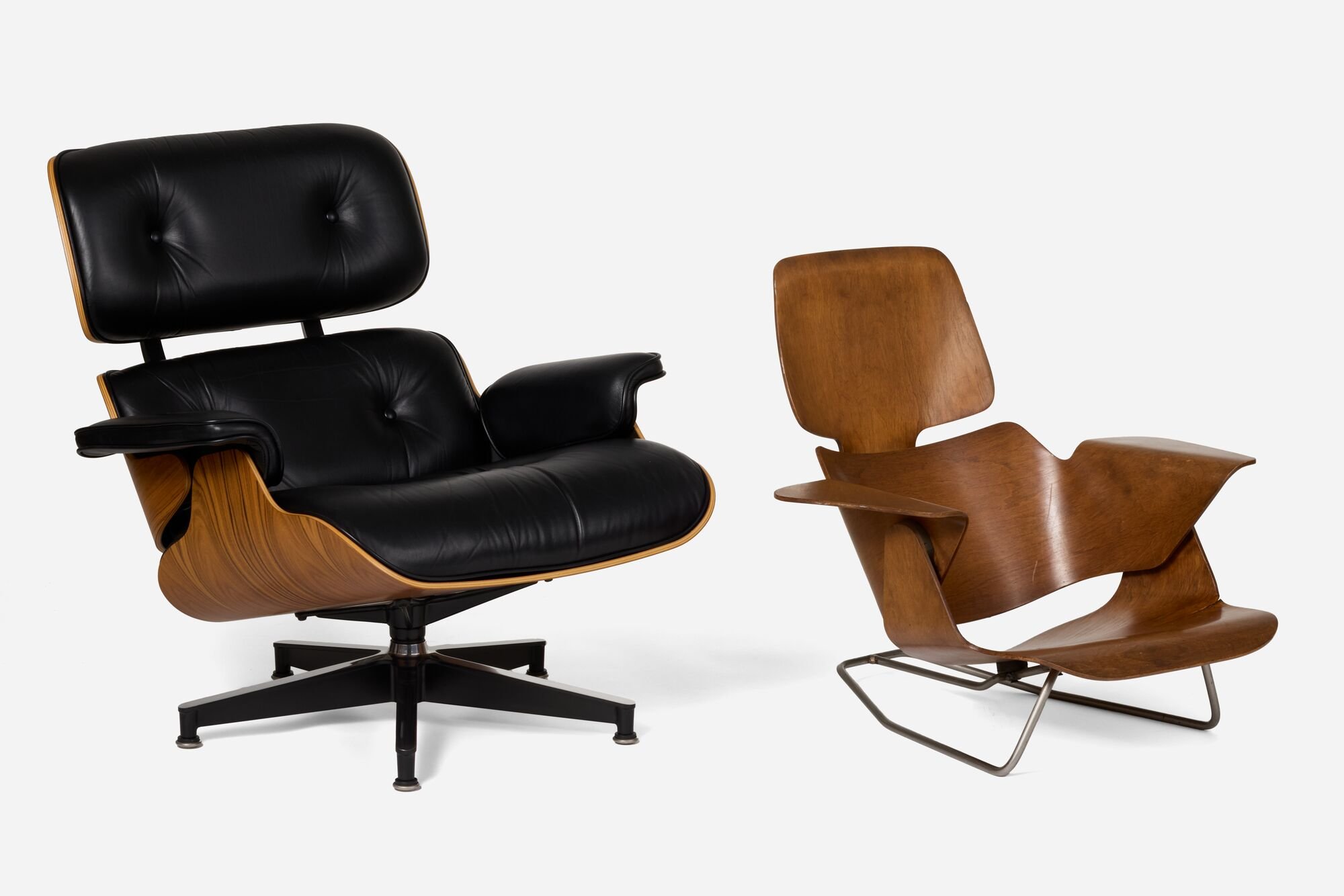
A 50th anniversary edition of the Eames Lounge Chair in a sustainable Palisander rosewood veneer (left) alongside an early prototype (right). Artifacts# 2019.2.193.1 and G.2025.62.1
For the first product brochure Ray and Charles Eames wrote, “The upholstered lounge chair and ottoman are a combination intended to give comfort for long periods of time such as reading or conversation after dinner or just relaxing and thinking. Size and relationships of the parts are most important…all of the parts are allowed a bit of movement in relation to each other.”
When the Eames Lounge Chair and Ottoman were introduced, 70 years ago this month, in March 1956, Ray and Charles presented it on primetime television’s Home show hosted by Arlene Francis. They brought a short film that they had made showing how the chair was assembled, from straightforward cast-metal and molded-wood components. From the outset, the chair was presented less as a matter of appearance than of engineering: how it was put together as well as how its parts related. What the television audience could not see was the longer development behind that presentation, and the sequence of decisions that resulted in the finished product.
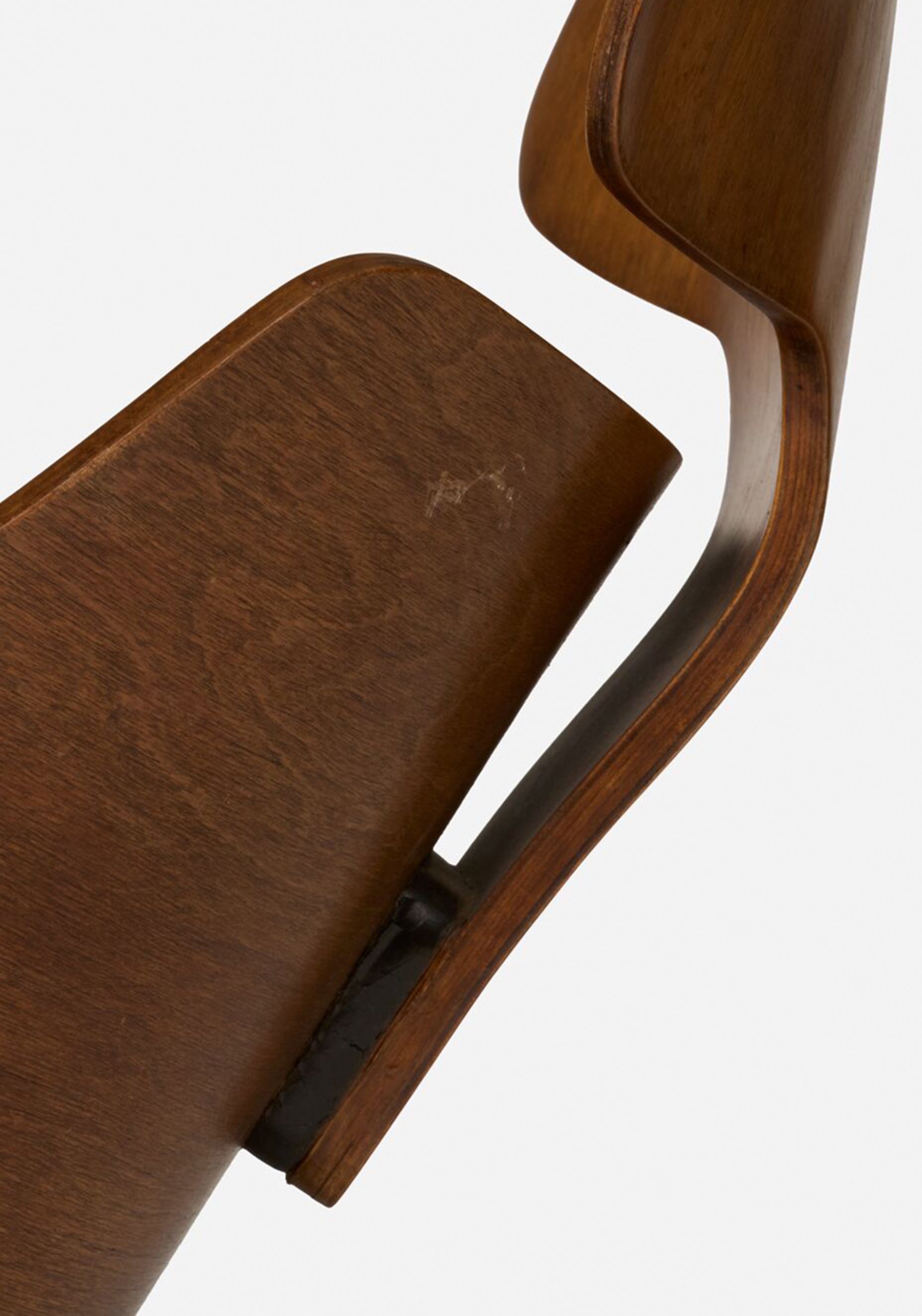
Artifact # G.2025.62.1
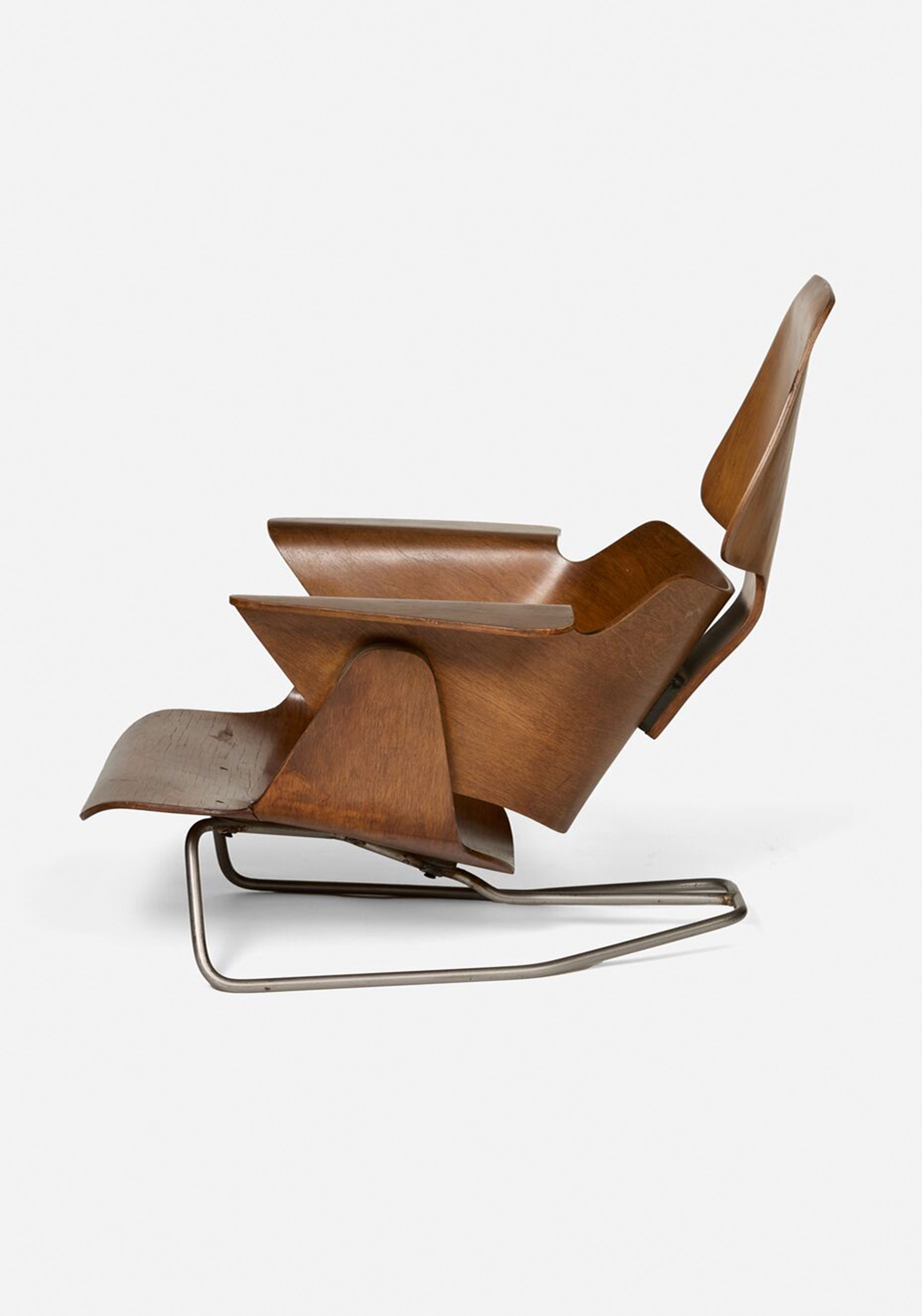
Early Prototype
An early prototype made in 1945, which is now in the Institute’s collection thanks to a recent generous donation, begins to make that history visible. The chair concept is already recognizable—molded plywood parts, including the broad seat, reclining back, and arms are in place. Some relationships are still being worked out. The prototype illustrates the thoroughness of the Eames approach to model making: It is made at full-scale and in the same structural materials as the eventual production design.
That working method is close to what Charles Eames later described as “Eero Saarinen’s trick”—dividing a problem into essential elements, studying each one repeatedly, and then recombining them without losing the quality found in the parts. In the case of the Lounge Chair, the program was framed in simple terms: to make a lounge with the qualities of a well-used first baseman’s mitt, combined with the presence of a traditional English club chair. The prototype can be understood in that light—not as a rough version of the final chair, but as one stage in working out that program.
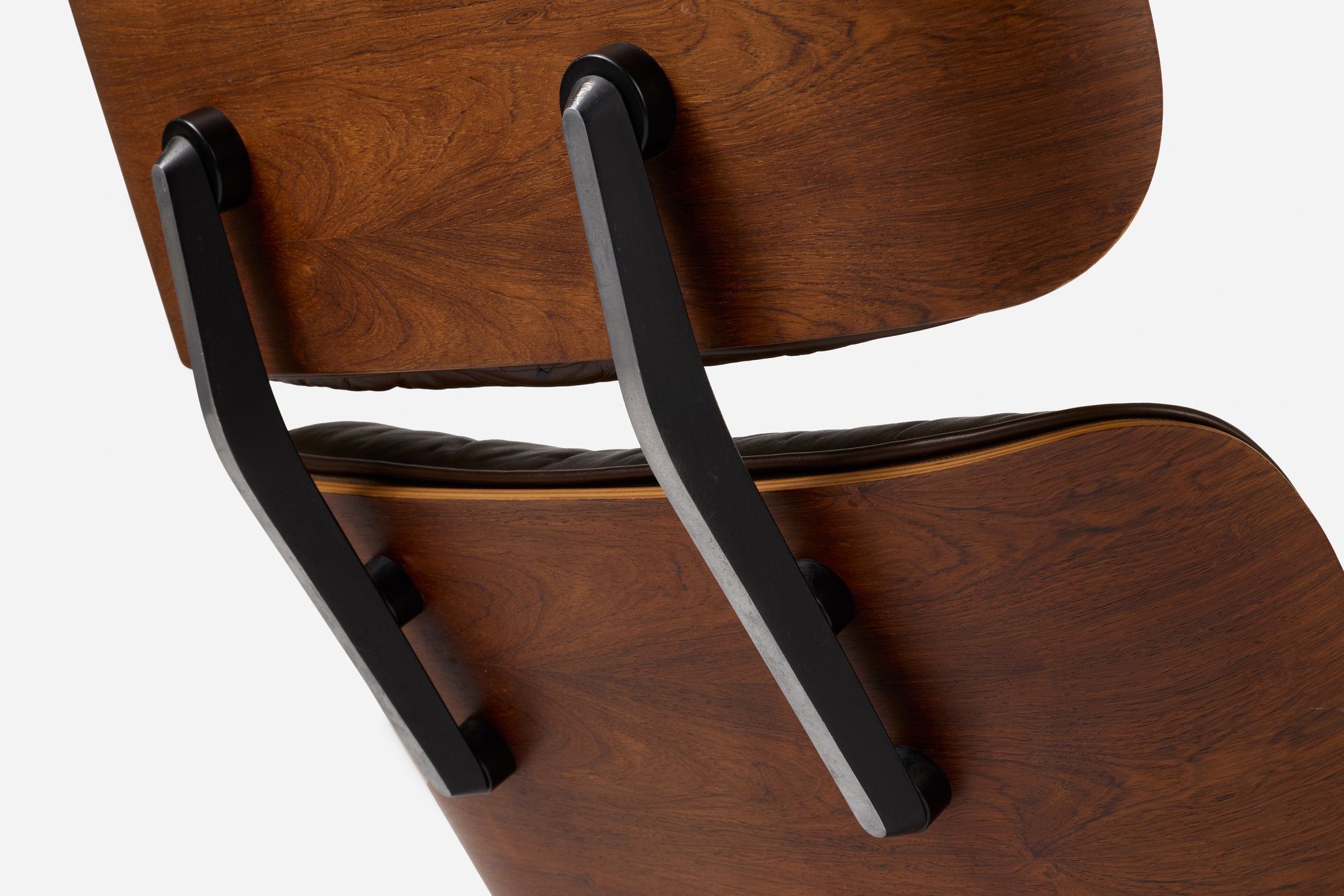
Aluminum back supports shown in their final form as two thin cast triangular shapes. Artifact # 2019.1.6.1
Wooden Model of Back Support—“A Hunk”
A second object in the collection shifts the focus from the chair as a whole to one specific part: a carved and painted wooden model for one of the aluminum back supports. Before that support could be cast, its shape had to be determined. This small object makes that stage visible. It points to something Charles often returned to: design includes not just the form of a thing but also how it can be made. As he put it, “When a product is designed in a way that its production varies from the norm…it becomes the responsibility of the designer to help make the necessary transition…”
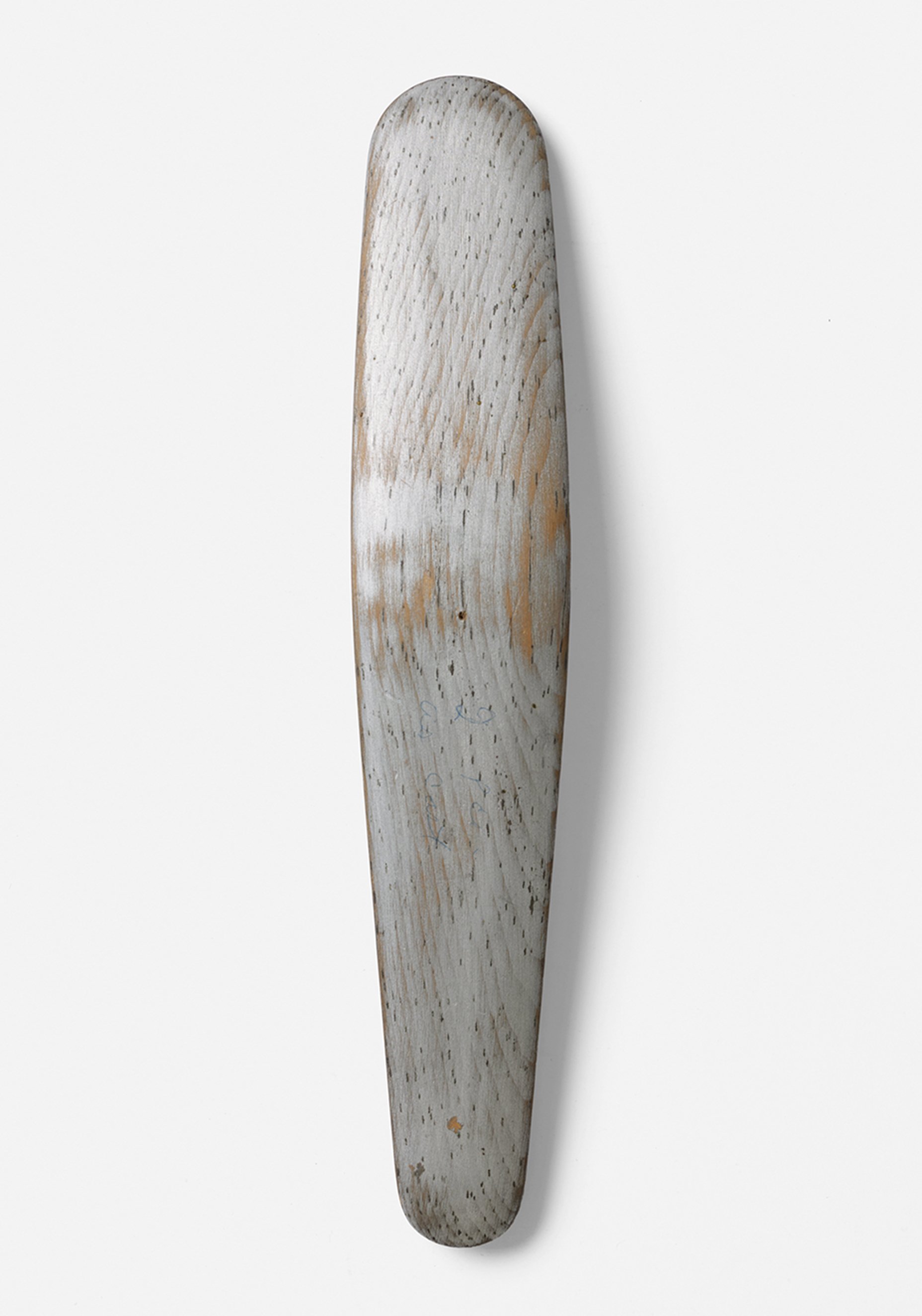
Artifact # P.2019.2.11.4
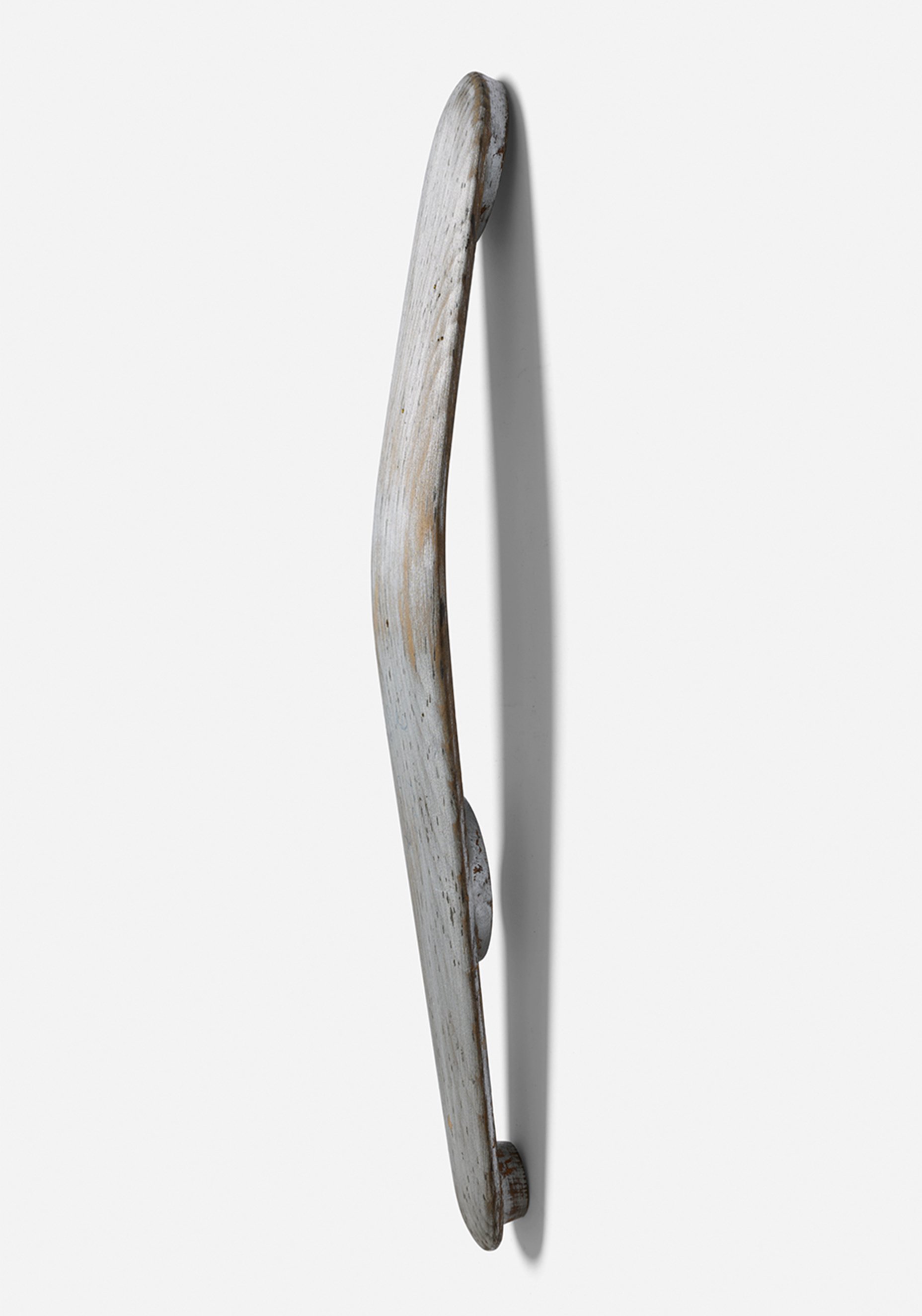
In an August 1955 letter to Charles, who was then in Paris, Ray explains the iteration of the back support. She writes that she “had Don (Albinson) try many back connections and it is now two thin cast triangular sections. Trim, neat, undesigny but cared for, rather than hunks or straps and relation, but no conflict with the base.” Together, the wooden part and the letter show two sides of the same process: the object itself, and the thinking that continued to revise it. (To read the full letter, see page 142 of An Eames Anthology.)
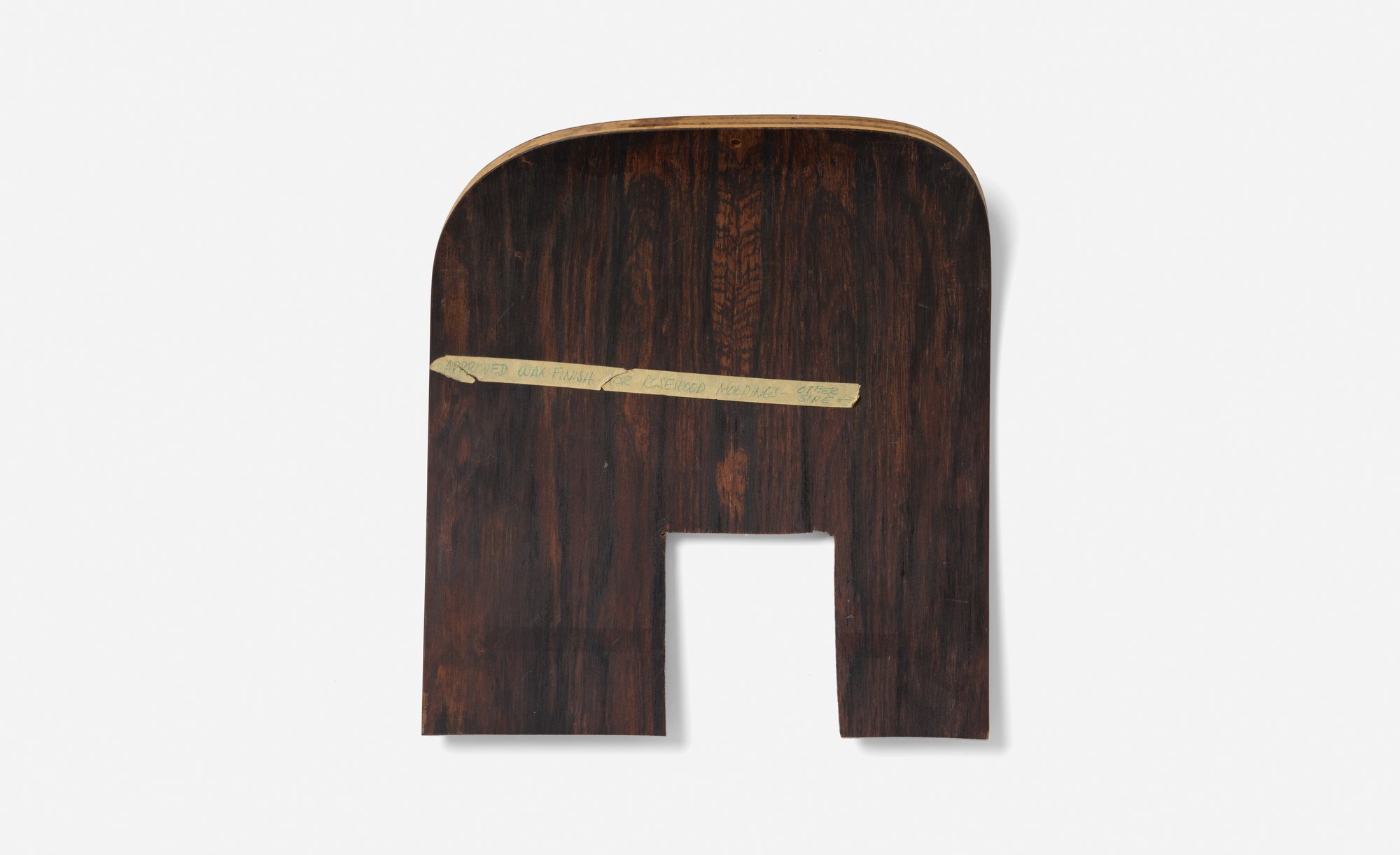
Artifact # P.2019.2.11.3
Rosewood Board
The rosewood board marked “approved finish” illustrates a different kind of decision. If the prototype shows the chair being tested, and the carved support shows a part being worked out, the rosewood board shows something being selected. It brings material, surface, and finish into the story. Charles addressed that kind of decision directly in 1961: “The details are not details—they make the product…the gauge of the wire, the selection of the wood, the finish of the castings—the connections, the connections, the connections.” The board suggests how closely material and finish were treated as part of the design itself, not as something added later.
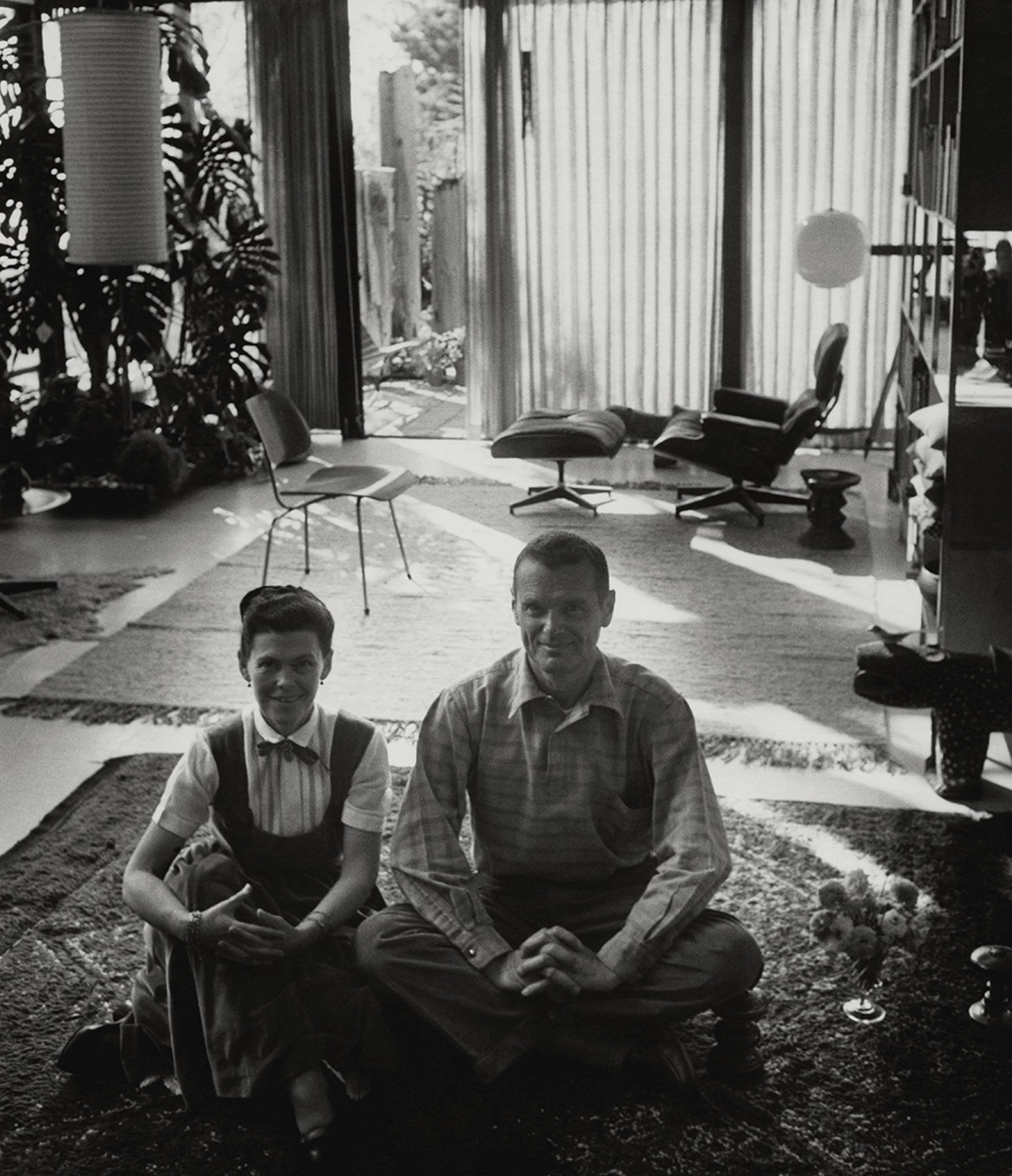
The details are not details—they make the product.
Charles Eames
Ray and Charles Eames in the living room of the Eames House. John Bryson/Vogue 1959 via Getty Images.
Seen together, these objects clarify the sequence behind the chair’s public debut. The prototype reveals an early stage in addressing the larger design problem. The carved and painted wooden support shows one part being revised toward its final form. The rosewood sample represents a later stage of approval and finish selection. By the time Ray and Charles Eames appeared on television in 1956 with a short film about assembly, this instant icon could be presented as the Lounge Chair and Ottoman in a finished form that is still in production by Herman Miller and Vitra seventy years later, reflecting the depth of testing, making, and selecting that had already taken place. ❤
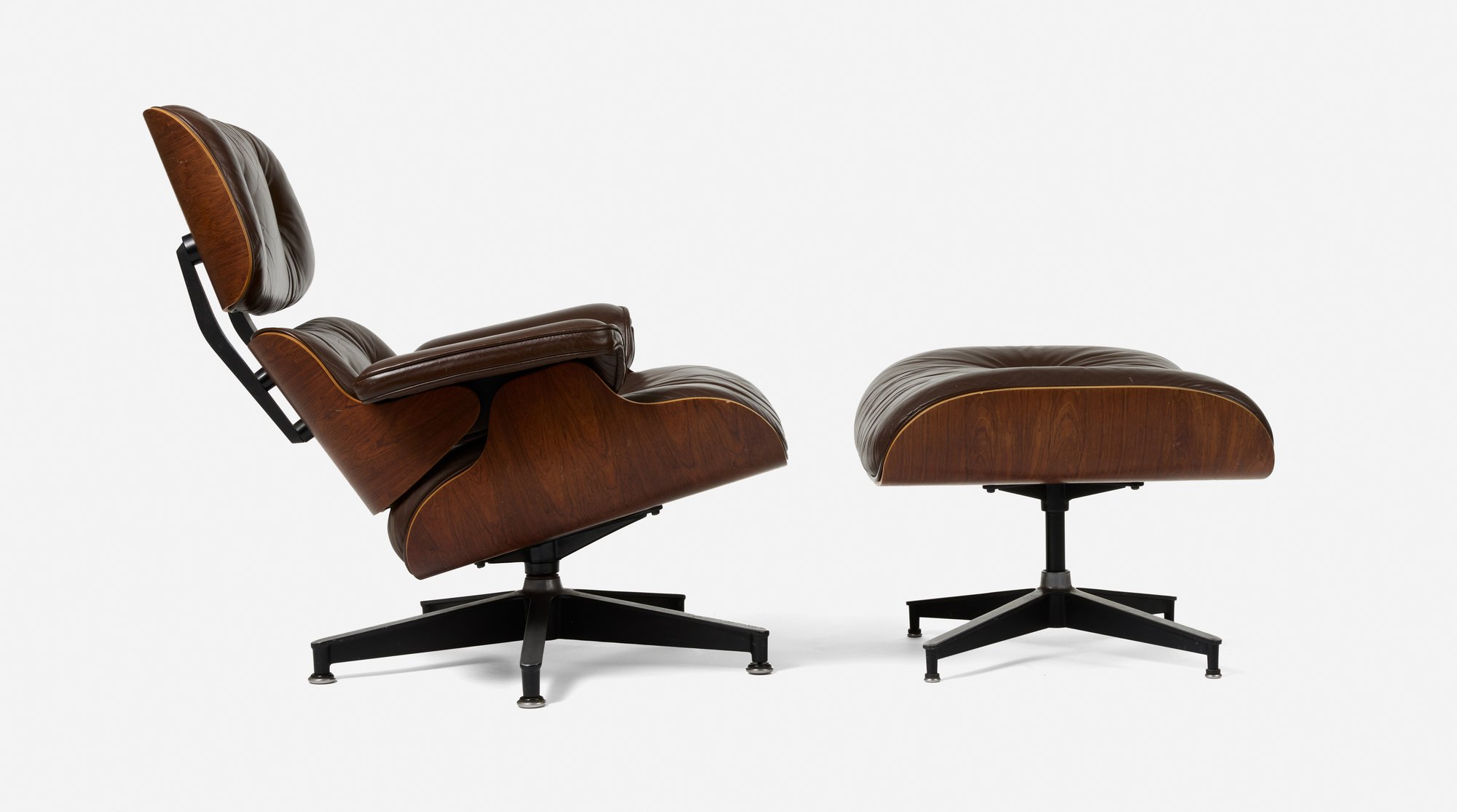
In 1979, Ray sent this brown leather and Brazilian rosewood Eames Lounge and Ottoman to Charles’s goddaughter, Adele Crispin. Artifact # 2019.1.6.1-2
—Daniel Ostroff is the Chief Scholar of the Eames Institute and the editor of An Eames Anthology (Yale University Press). Ostroff was a consultant to the Eames Office from 2006 to 2025, and has been an advisor to Herman Miller, Vitra, and museums globally.
At Kazam! Magazine we believe design has the power to change the world. Our stories feature people, projects, and ideas that are shaping a better tomorrow.